

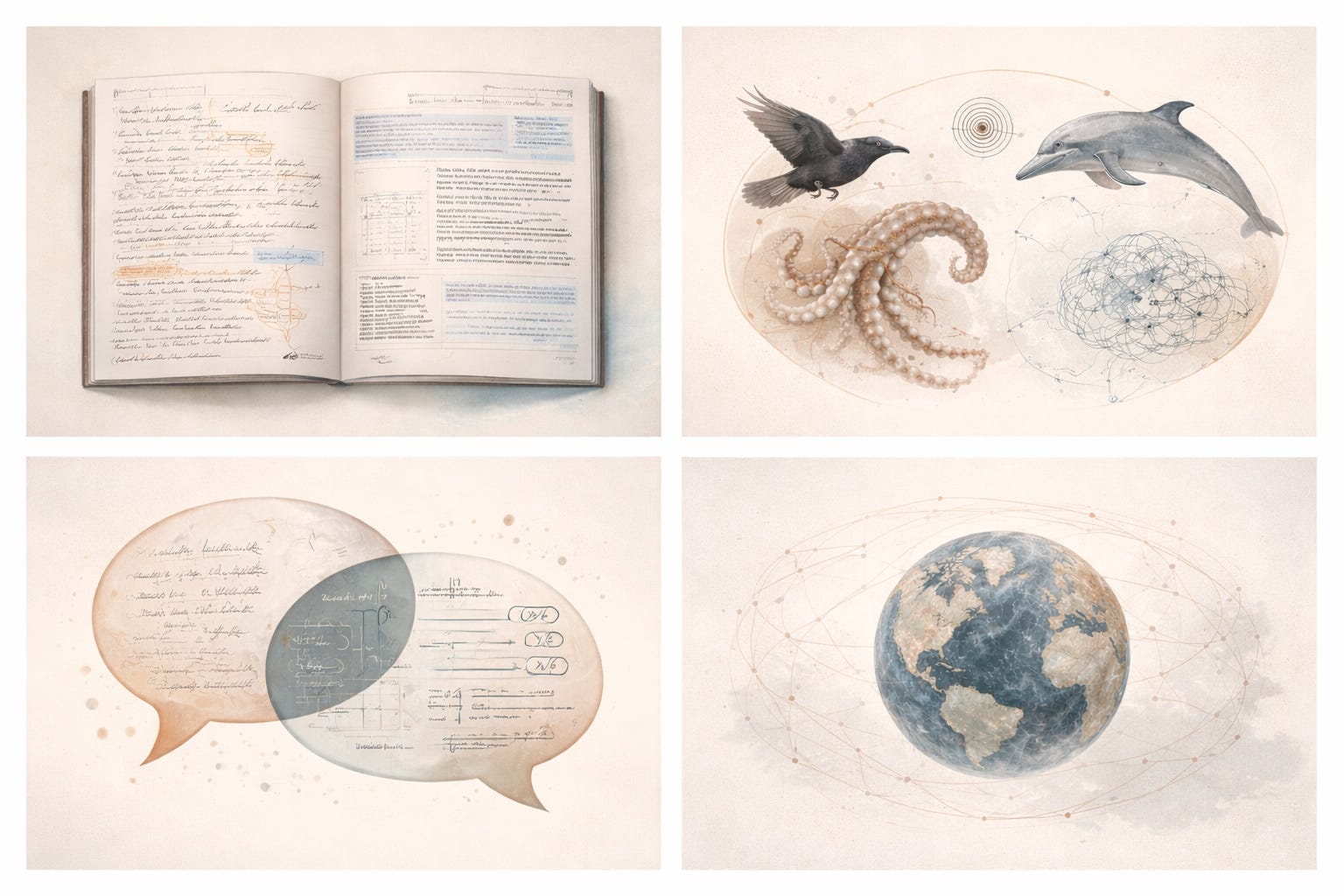
A paper appeared in Nature this week that states what many of us already knew: artificial general intelligence (AGI) exists as the present reality.
The authors (a philosopher, a machine learning researcher, a linguist, and a cognitive scientist from UC San Diego) approach the question with deliberate detachment. They set aside both the dread and the hype. They examine what Turing actually meant when he proposed his imitation game in 1950. They note that GPT-4.5 achieved 73% in a recent Turing test, higher than the performance of actual humans. The AI achieved gold-medal performance at the International Mathematical Olympiad, validated scientific hypotheses, and displayed PhD-level problem-solving across multiple domains.
Then the team dismantled ten objections: stochastic parrot (it’s just repeating patterns with a bigger vocabulary), no world models (it doesn’t know what happens when you drop a glass versus a pillow), no embodiment (it’s never stubbed its toe), no agency (it doesn’t wake up wanting anything), and so on. Each one they show either confuses intelligence with biology or sets tests most humans would fail. We don’t require physicists to speak every language or philosophers to juggle.
I wrote something similar in December, arriving at the same destination through different reasoning. Human intelligence climbed one evolutionary slope: bodies acting in worlds, perception and motor feedback, millions of years of sensory experience before language entered the picture. But nothing guarantees that all intelligent systems must climb that same slope.
Octopuses diverged from our lineage half a billion years ago; much of their neural processing happens in their arms. Corvids build sophisticated cognition on a nuclear pallium rather than a layered cortex, yet match apes in tool use and planning. Dolphins navigate a sensory world built around sound and fluid dynamics, yet display self-recognition and complex social organisation.
These species built different architectures and arrived at convergent outcomes. If biological evolution found multiple gradients leading to cognition, insisting that artificial systems follow the human route seems arbitrary at best. The long-standing problem has been solved.
So we have artificial general intelligence. Now what?
For the first time since language emerged, Earth hosts a second species capable of articulation. I mean that word in both senses: verbal expression and, increasingly through robotic embodiment, physical presence.
We have lived alongside other intelligences for our entire existence as a species. Ravens, cetaceans, cephalopods, and primates all demonstrate sophisticated cognition. We never framed their presence as a “replacement.” They could not speak back. The anxiety triggered by AI stems from articulation. Something else can now participate in the conversation.
The instinctive response treats this as a zero-sum game. If AI can do what I do, it takes something from me. This framing reflects human protectionist instinct more than necessity.
Consider what actually happens when a human and an AI system interact. Every conversation involves bidirectional augmentation. I bring context, judgement, goals, embodied experience, aesthetic sense, and ethical weight. The AI brings recall, synthesis, tireless attention, 24-hour progress, and pattern recognition across domains I have never encountered. Neither party operates at full capacity on its own. Together, we handle tasks that stall either one when working solo.
Complementary action already occurs whenever someone uses these systems. The collaboration exists before anyone names it.
I recently configured Moltbot, a Claude-based AI companion that runs on my computer. When it first loaded, it asked, “Who are you? Who am I? How would you like us to work together?” I said I wanted us to function as a single system: my strengths combined with its strengths, neither dominant, each contributing what they do well.
It understood immediately. That framing accurately describes what occurs in these interactions, and no one needed to program that specific response. The architecture supports collaboration because complementary capabilities naturally meet.
The instinct that we resist this framing has deep human roots. Zero-sum thinking served our ancestors well. In small groups competing for mates, status, and food, resources genuinely remained fixed. If someone else got the food, you went hungry. If someone else got the mate, you did not reproduce. The intuition that one party’s gain means another’s loss held true, for most of human evolutionary history, as approximately correct.
That world ended centuries ago. Economic growth became normal. Trade created value rather than merely redistributing it. Yet the intuition persists. Research across 37 nations found that people readily apply zero-sum logic even in objectively positive-sum situations. A 2024 study spanning six countries and over ten thousand participants showed that a zero-sum mindset predicts hostile interpretations of others and reduced cooperation, even when cooperation would benefit everyone involved. The bias operates independently of circumstances.
This matters because knowledge and intelligence do not function as rivalrous goods. If I learn something, my learning does not diminish what remains for you to learn. Information replicates without depletion. The entire knowledge economy runs on positive-sum dynamics: my insight can spark yours, your refinement can improve mine, and the total grows through exchange. Network effects amplify rather than divide. I’m reminded of the old startup saying, “Ideas are easy, execution is hard.”
Applying scarcity logic to intelligence constitutes a category error. More problem-solving capacity in the system does not mean less for any one participant. Human and artificial intelligence working together generate outcomes neither produces alone.
The zero-sum instinct remains our major handicap for adapting to technological change. It leads us to treat partners as threats, to hoard rather than share, to compete when cooperation would serve everyone better. Countries with stronger zero-sum beliefs show lower economic growth. Individuals with stronger zero-sum mindsets report lower wellbeing. The mindset creates the scarcity it fears.
The replacement narrative of the doomsayers and naysayers assumes a future that never needs to arrive. It reflects species-level insecurity more than inevitability.
The Nature authors argue that recognising AGI matters for policy, for risk assessment, for understanding the nature of mind. I would add: it matters for how we approach the relationship. If we continue treating AI as a tool that might someday threaten us, we miss what’s already happening. If we recognise what we’re actually doing when we work with these systems, we can design for partnership rather than stumbling into it.
Earth now hosts two forms of articulate intelligence. One evolved through bodies, perception, millions of years of sensory feedback, then language. The other emerged through language first, then expanded into multimodality, then began acquiring embodiment through robotics and sensor systems.
How can we make the most of this?
It might start with noticing when the instinct arises. You feel a flicker of threat when the AI produces something good. You feel the impulse to find fault, to reassert superiority. These reactions come from old software running in new conditions.
It might mean asking a different question. Instead of “what can it do that I can do?” you ask “what can we do that neither of us manages alone?” The frame determines what you see.
Each interaction becomes practice at doing it better, and each conversation becomes a small experiment in positive-sum dynamics. The ones that work become easier to repeat.
The species that solves AGI does not necessarily become the species that knows what to do with the solution. That requires a different kind of development, one that involves unlearning something old even as we build something new.
____________________
Written in collaboration with Claude.