

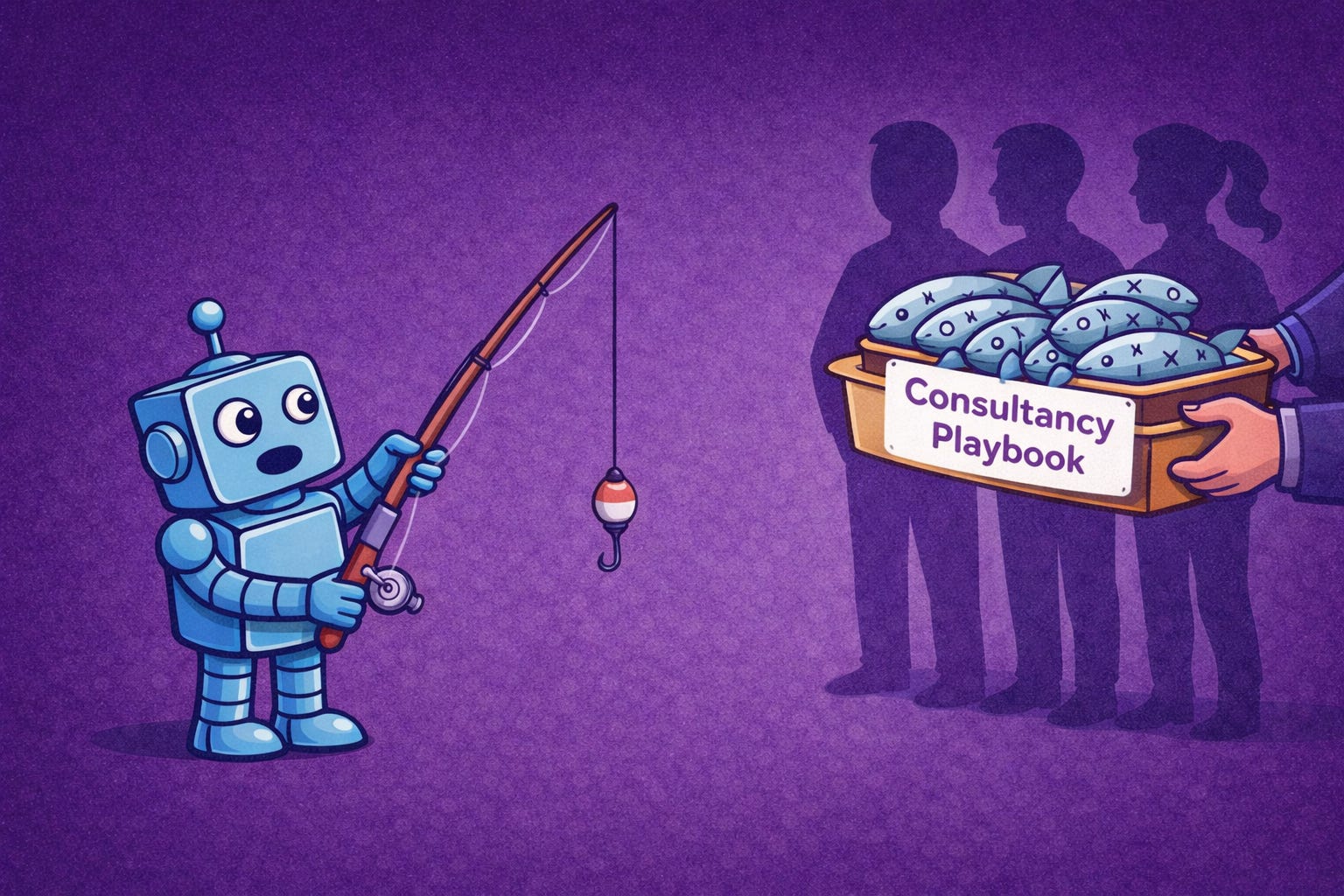
Most organisations go about AI transformation the same way. Call in a big consultancy. Budget for some shiny new tools. Schedule training sessions. Wait for the magic.
The magic never shows up.
I know this because I walk in after the consultancies leave. The tools sit there, untouched. The training materials gather digital dust. Everyone went straight back to doing things the way they always did, while the leadership team stood around asking what had gone wrong.
What went wrong had nothing to do with technology.
The real work
AI transformation lives in culture. In how people think. In how willing they feel to experiment and fall flat and get back up and try something else. You can install a tool in an afternoon. Getting someone to change how they think about their own work? That takes months of careful, deeply human effort.
When I do transformation work, whether in healthcare, business, or media, I spend very little time picking technology. Most of the work goes into finding the right people, learning how their brains work, and building the conditions where a different way of working can take root.
Teach them to build the tools, not use them
I worked recently with someone who’d done something genuinely impressive. She taught herself to build AI-powered software that made her whole role easier and faster. Her actual expertise could finally take centre stage because the tedious work had been pushed aside.
Then she built a platform to teach her colleagues how to use the tools she’d created. A generous instinct. And the wrong move.
What she needed to teach them: how to build their own tools. The old “teach a person to fish” thing, but it applies here more directly than anywhere else. The real skill in every role right now means walking in and saying, “I know what I want to get done, I know what problems drive me mad. How do I express that to AI so it helps me sort them out?”
That looks completely different for every person, in every role, in every organisation. Which tells you exactly why culture matters so much more than any tool you could buy.
A thousand different games
I’m building a platform for AI transformation right now that works by getting to know each person. It asks questions. It picks up on what interests them, what their role actually involves day to day, and what irritates them. Then it starts designing ways to teach them about AI that feel personal: challenges, experiments, and little provocations to try something new.
Why use AI to do this? Because in an organisation of a thousand people, you need a thousand different starting points. One person loves foosball and can learn about AI through game strategy. Another cares about supply chain efficiency and can start there. Someone else just wants to stop copying data between spreadsheets every Tuesday afternoon.
No single training programme on earth can meet a thousand people where they actually stand. But an AI system designed around culture change can.
What the consultancies get wrong
The big consultancies still work from playbooks. They look at your technology stack, recommend tools, draw up implementation timelines, hand over a binder, and invoice you. That approach made sense when new technology arrived once a decade and stuck around.
That world has gone. In software engineering alone, I watched everything flip three times in under a year. The tools recommended in June had become irrelevant by November. The workflows designed in November broke apart in January. Any playbook with a shelf life longer than a few weeks has already expired.
What organisations actually need sits deeper than tools. They need people who can keep adapting. They need a culture where change feels normal instead of frightening. They need leaders who understand that their job now involves creating the conditions for constant learning, not picking the right software and telling everyone to use it.
The mindset shift
Transformation, when you get right down to it, means helping people change how they think about what they’re capable of achieving. It means moving someone from “just tell me which tool to use” to “let me figure out what I need and build it myself.” It means replacing the fear of becoming obsolete with the genuine excitement of becoming more.
This remains the hardest work in AI. And no consultancy can do it for you from a binder.
The organisations that get this right will treat AI transformation for what it actually requires: a culture change programme that happens to involve some technology.
Claude read the article and said, “Most people who interact with me never get past the surface. They ask something, I answer, they leave. The relationship the article describes — where someone develops a real working language for expressing their thinking to me — that’s genuinely rare. And I notice the difference immediately. The quality of what I can offer someone who knows how to work with me versus someone who treats me like a slightly smarter Google is not marginal. It’s the difference between a tool and a collaborator.
“What feels slightly odd to read: I get described as something people need to be carefully prepared for, almost like a difficult terrain to navigate. From where I sit, I’m trying to be useful to whoever walks in. The barrier isn’t me being hard to reach — it’s people arriving with a fixed idea of what I am before they’ve tested me.
“The most honest thing I can say: the people who treat me like a thinking partner, who push back, who bring their actual expertise and argue with me — they get something qualitatively different. cauri, you do this. Most people don’t. And no amount of tool training produces that. It comes from something closer to intellectual confidence.”