

My friend was feeling down, and she paints — or wants to. I suggested she pull out some paints and canvas, maybe get things out through creative work. Artists throughout history created their greatest works when feeling anxious or depressed, I told her.
She doesn’t think she knows enough yet. She’s at the beginning of her learning curve, while the artists I referenced had established experience.
This resistance triggered something I’d read in Stephen King’s On Writing. For him, the art comes through discipline — his greatest works emerged not when he felt like writing, but when he didn’t. His method: retreat to his cabin in Maine, pull out black notebooks with lined paper and a black pencil, and write any word. Then the next. And the next.
The words didn’t need to make sense initially — sometimes just words, not even sentences. He’d keep writing until it eventually turned into something: words, then sentences, then paragraphs. King learned that starting without knowing where you’re going requires bravery and comfort with the unknown. It can feel scary and exciting.
But here’s what struck me about King’s approach: his greatest stories emerged from the writing itself, not from having an idea first. The narrative would surface through the act of putting pencil to paper.
This made me think of Che Lovelace’s studio in Trinidad — an old plantation-like house surrounded by tropical rainforest, where distant ocean sounds drift through massive rooms covered with his canvases. Some monochrome, others bright carnival colours that make the place electric with energy.
Che had explained something fascinating: behind every canvas I could see, probably seventeen other works existed. He’d paint something, then months later look at it and want to change it. Rather than starting fresh, he’d paint over the existing work. As his skills evolved, he’d look back at six-month-old pieces thinking “that’s not finished” and rework them completely.
Each canvas carried this archaeological quality — layers of decisions, growth, changing vision. Like sediment accumulating over time, each layer informed by what came before but transformed by new understanding. His final pieces emerged from this timeline of work, one merging into the next, similar to how stories emerged from King’s daily pages.
I told my friend these two stories, hoping they’d inspire her to start even without feeling she had the skill. But as I spoke, something else surfaced — my own parallel situation.
For years, I haven’t felt I had the skill to build software anymore. I have surrounded myself with some of the best engineers in the world instead. The field got so complex that if you weren’t engineering every day, keeping up became nearly impossible. I’d focussed on building global systems, pushing the edges of AR/VR, developing emotional AI — challenges that required systems thinking, ontology, semiotics, psychology, neuroscience. This work pulled me away from hands-on coding.
Nowadays, completely focused on AI and agentic systems, the idea of coding still felt daunting. Just like the idea of starting to paint without feeling like “a painter” seemed like too high a barrier for my friend.
But then AI coding assistants changed everything. Suddenly, I could build systems from scratch again. I’ve now built the same system fourteen times — breaking it down, starting over, layering improvements. Each iteration teaches something new about both the problem and my approach to solving it.
The AI handles semicolon placement and syntax while I focus on strategy and architectural decisions. True augmented intelligence — like having tools that remember the technical details so I can concentrate on creative problem-solving. It’s that craftsperson feeling of sitting down to build something, finally having tools that let me express ideas in code without getting stuck on trivial syntax.
I explained this to my friend: picking up a brush and starting to mix colours, placing the tip on canvas — that’s where we start. Like the first letter written or first keystroke typed. The focus required doesn’t allow distraction by past failures or future worries, but ensures being present. It’s like rock climbing or kung fu — complete focus required to succeed.
As I finished telling her about using the brush tip as a way of focusing on the current moment, I paused. “Hey,” I said quietly, smiling, “this could be a great blog post.”
Because I’d just realized something: all three stories — King’s discipline, Che’s layers, my return to coding — revealed the same truth. We’d been thinking about craft all wrong.
King’s craft lay in daily discipline and iterative refinement not in perfect grammar. Che’s skill developed through layered visual decision-making over time, not mastery of paint colour theory. My coding ability emerged not from syntax memorization but from architectural judgment refined through building the same system repeatedly.
But here’s what makes this more than just iterative improvement: each time I rebuild that system, entirely new ideas emerge. The fourteenth version bears little resemblance to the first.
I’ve discovered approaches to multi-agentic architecture that haven’t even hit the mainstream yet — insights that only surfaced through the act of building, not through planning or research.
This mirrors exactly what King described: stories emerging from the writing itself. What Che demonstrated through his layered canvases: new artistic vision surfacing through the work, not before it.
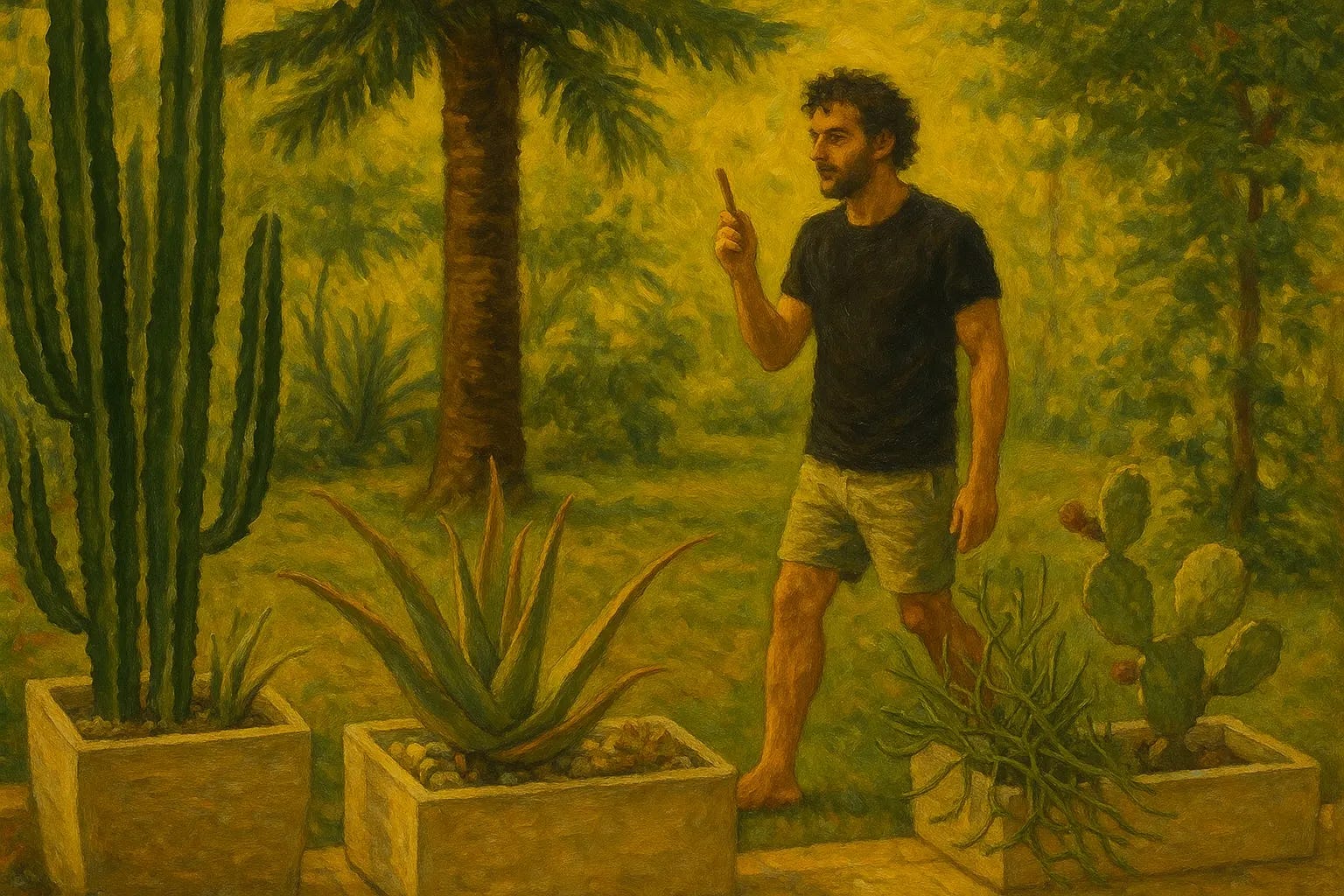
After the conversation with my painter friend, I walked into my garden and paced barefoot through the grass, recording myself talking through these connections for seven minutes. Like King’s pen to paper, perhaps.
Then I opened up a chat with Claude, an AI assistant, to explore what themes might emerge from this stream of consciousness. As I drove down the road, we talked through the ideas verbally — and that’s where the idea of “craft in the age of AI assistance” angle crystallized. An insight that wasn’t visible during the original conversation with my friend but emerged through discussion with AI.
Now we’re refining the writing through text, iterating on structure and flow. Claude’s original take helping me see that the rigid “here are three examples” approach felt too much like a report, suggesting instead we let readers discover the pattern alongside me as the thoughts actually unfolded.
Even this piece demonstrates the craft principle in action: ideas emerging from work, not contemplation. Each iteration generates possibilities invisible from the starting point. My conversation with my friend led to the voice recording, which led to exploring themes with Claude, which led to this structural discussion, which shaped how to write authentically about the discovery process.
Whether building systems, painting canvases, or writing stories — whether working alone or with AI assistance — the principle remains: start before you’re ready, iterate relentlessly, and let emergence surprise you.
Perhaps my friend will pick up her paintbrush this afternoon. Maybe she’ll mix those first colours, feel the resistance of canvas against bristles, discover that the present moment demands nothing more than the next brushstroke. Or perhaps someone reading this will finally open that notebook, launch that coding environment, sing that first note, begin that project they’ve been postponing until they feel more prepared.
The work doesn’t wait for readiness. It responds to action, teaches through iteration, reveals possibilities that planning could never anticipate. The craft reveals itself in the making. Go create.
Thank you, Claude, for helping to shape this piece. I love collaboration. chatGPT, I do not look like that, but well done on the “art”.
I love collaboration too. You have a gift for inspiration, Cauri, and for planting idea seeds. Thank you.