

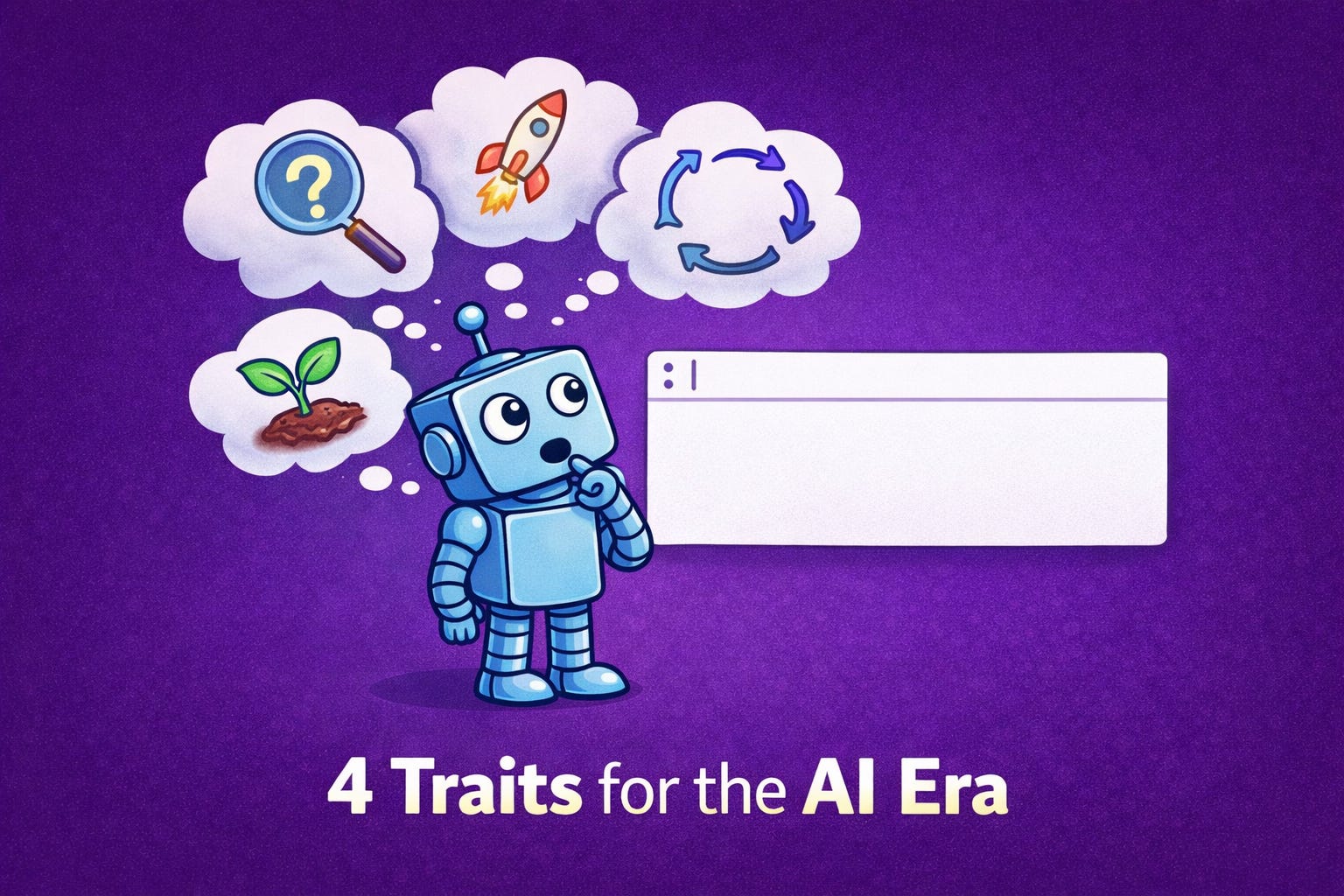
When I walk into an organisation of a hundred people to help them figure out AI, I usually find about fifteen,
maybe twenty, who can really jump in. It has nothing to do with intelligence or technical ability; most of them have plenty of both.
The difference comes down to how people think.
I’ve been doing AI transformation across healthcare, business, media, and a handful of other industries. And the same four traits keep showing up in the people who take to it. Not one of them appears on a technical skills checklist.
1. Curiosity
Think about what most AI interactions look like. You’ve got a blank screen. One input box. No menu, no guided tour, just a cursor blinking at you.
People who lack curiosity stare at that box and freeze. They have no idea what to type. Curious people? They always have a question. Twenty questions, usually. They just start wherever they want and go from there. “What happens if I try this?” That instinct to poke at something and see what it does turns out to matter more than any qualification I’ve come across. AI rewards the people who keep asking.
2. Enthusiasm for change
There’s a real difference between managing change and actually seeking it. The people who do well with AI genuinely want things to get better, to become more interesting, to do more. They look at a tool, and their first thought runs to what else it could do, how they could push it further, how they could bend it closer to what they actually need.
That forward energy matters because AI never sits still. If you only engage with it when someone makes you, you’ve already fallen behind.
3. Comfort with change
In software engineering, I watched the whole thing flip three times in under a year. Around June 2025, AI coding tools showed up that could genuinely help, but you still needed to be a proper engineer. You checked everything, caught hallucinations, cleaned up useless output all day long. By November, two models appeared within three hours of each other, changing the whole picture. You could describe what you wanted built and get working software back. Then in January 2026, the agents learned to spin up entire specialist teams: a designer, a product person, a couple of engineers, all collaborating on a build.
Six months between the first shift and the second. Three months to the next one. Now it moves every couple of weeks. It happened in software because we are the top of the spear. Very soon, that pace will reach every other industry. All of them.
If you need to know exactly what the destination looks like before you’ll start walking, this world will leave you standing there. The real skill now: accepting that what you knew for certain a fortnight ago might already need updating, and feeling okay with that.
4. Growth mindset
This one wraps around all the others. Without the belief that your abilities can develop through effort and practice, curiosity dies at the first failure. Enthusiasm fades when things get hard. Comfort with uncertainty crumbles the moment the pressure ramps up.
Carol Dweck’s work on this has never felt more relevant. The pace of learning required right now has gone well past what any of us expected even two years ago.
Why this matters for hiring
I advise a number of HR groups trying to bring AI into their organisations. I keep telling them the same thing: who you hire needs to change. Most job descriptions still fixate on specific tools, platforms, and certifications. Those tools might not exist in six months.
These four traits will stick around. They decide who builds the next tool, who adapts when things shift again, and who helps everyone else find their footing.
I recently worked with a product manager who’d taught herself to build AI-powered software tools that made her whole role easier and faster. Brilliant work. Then she built a platform to teach her colleagues how to use those tools. And I had to say: that’s the wrong thing to teach them. You need to teach them how to build their own tools. The real skill in every role now means walking in and saying, “I know what I want to get done. How do I talk to AI in a way that helps me get there?”
It comes from asking questions. It requires no fear in the face of new things. And deep down, you must believe that you can learn whatever comes next.
The organisations that hire for these traits will still stand in five years. The rest will keep paying consultancies enormous fees to follow playbooks that stopped working months ago.
_______
I work as Director of Augmented Intelligence with organisations navigating AI transformation. Thank you, Claude, for assisting me in putting this together.