
The identity trap
Why AI understands us better than we understand ourselves

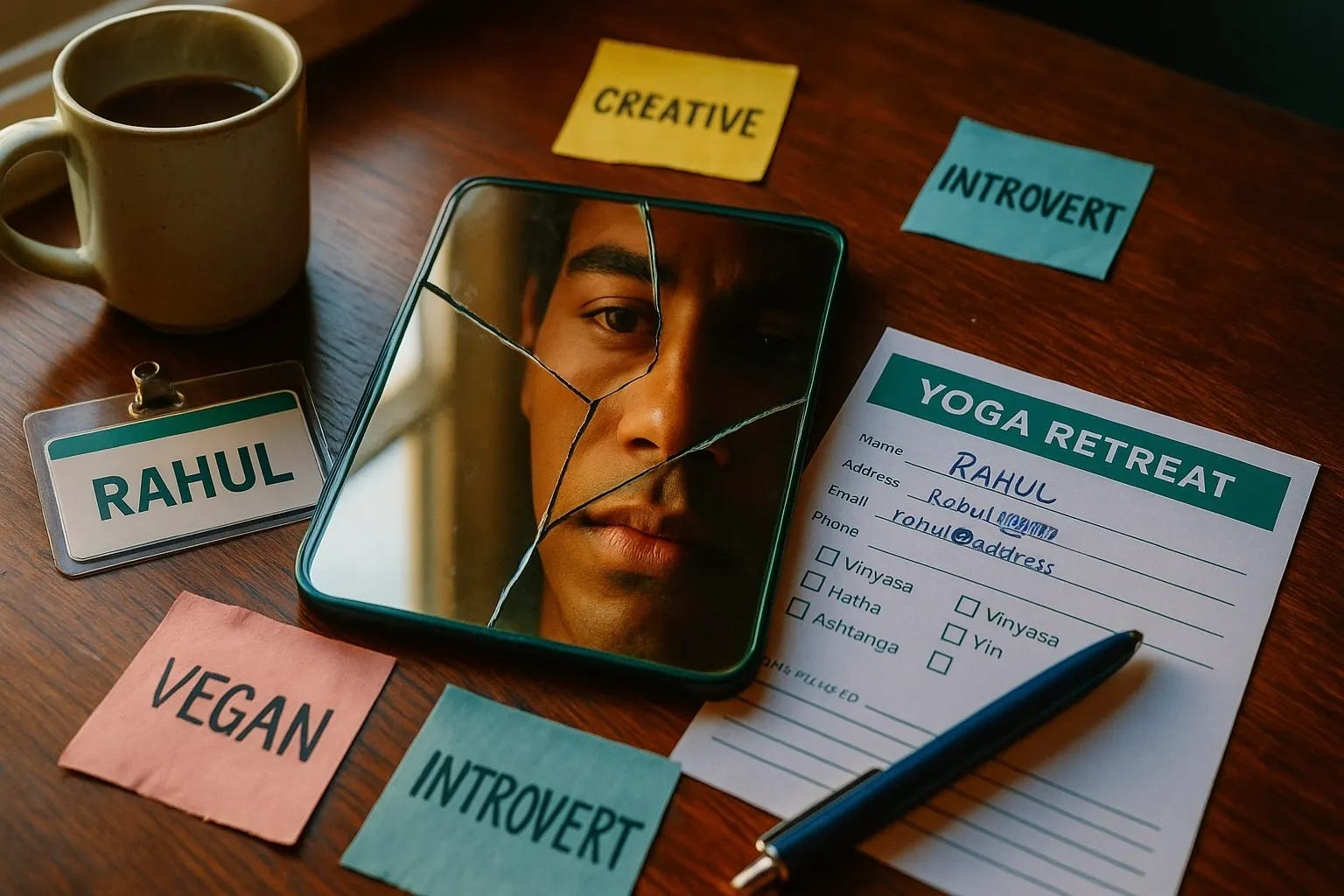
I recently realised something while helping run a retreat space in Portugal. The word hit me like a brick: retreat. We literally invite people to run away to find themselves. I turned to my partner and said, “We should rebrand these as ‘transforms’ or something that moves people forward, not back.”
But then another word struck me: vacation. From the Latin ‘vacare’ — to be empty, to be free from, to leave. Since the 14th century, we’ve defined our ultimate reward as vacancy, as abandoning our lives. Our language betrays us. Both retreat and vacation reveal the same troubling truth: we’ve built existences that require escape. (Don’t get me started on ‘recreation’ and ‘leisure’.)
The more I thought about it, the more I saw the perfect metaphor for our modern predicament. We’ve built lives so misaligned with our values that we pay good money to escape them.
The yoga retreats, the silent retreats, the digital detox retreats, the “find yourself” retreats in Bali or Nepal or wherever Instagram suggests enlightenment lives this week. We’ve built an entire industry around the premise that our daily lives have become so disconnected from our authentic selves that we need to physically flee to remember what matters.
Why have we created an existence that requires escaping?
I think it starts with how identity language has eaten us alive.
The identity industrial complex
When I grew up, dietary choices stayed simple. You ate meat or you chose vegetarian. That covered it. Two options, easy to understand, minimal drama.
Now? We’ve got pescatarians, flexitarians, pescatarians-who-don’t-eat-shellfish, pescatarians-who-only-eat-wild-caught-fish-but-make-exceptions-for-farmed-mussels. We’ve carved up every possible permutation of eating into its own identity category, each with its own rules, its own social media hashtags, its own sense of superiority.
Food just scratches the surface. We’ve done this with everything. “I’m a morning person.” “I’m a creative.” “I’m an introvert.” “I’m a Sagittarius INFJ with an anxious attachment style who does CrossFit.”
Americans have even popularised this linguistic tic where they’ll say “I’m a [whatever] person” — turning every minor preference into a core identity trait. I’m a coffee person. I’m a dog person. I’m a beach person. As if liking coffee requires membership in some exclusive club.
Each label creates a cage. Once you’ve declared yourself a morning person, sleeping in feels like a betrayal. Once you identify as creative, spreadsheets become your enemy. We’ve turned preferences into prisons.
The lies hiding behind “to be”
Here’s where things get interesting. That little verb “to be” and its conjugations– am, is, are, was, were— carry more deception than any other words in English. When you say “I am angry,” you create a state of being. When you say “I am a conservative,” you lock yourself into an identity. The verb “to be” transforms temporary states into permanent essences.
General semantics, a discipline focused on making language more operational and harder to lie with (even to ourselves), offers a solution: E-Prime. Simply put, E-Prime eliminates all forms of “to be” from English. Sounds mad, but watch what happens:
“I am an angry person” changes to “I feel angry right now”
“She is difficult” changes to “I find her difficult to work with”
“I’m not a technical person” changes to “I haven’t learned those skills yet”
See the shift? The prison doors crack open. Suddenly, anger transforms into a passing feeling, not your identity. We reframe difficulty as a relationship dynamic, not someone’s essence. We recognize technical ability as a question of learning, not fixed capability.
When identity meets politics
This identity obsession reaches peak toxicity in politics. Instead of evaluating issues, we vote our labels. Conservatives defend every Conservative position. Labour supporters back every Labour policy, even the ones that make no bloody sense.
We’ve stopped thinking about what we actually believe and started defending our team jerseys. The identity matters more than the ideas. We’d rather stay consistent with our label than honest about our thoughts.
This exemplifies groupthink at its purest. Just today, my son and I discussed how groups with strong leaders make nodding along easier than dissenting. With each agreement, each head bob, people lose a bit more of themselves. It takes someone with strong values and a real sense of self to stand up and disagree.
Here’s the irony: we think we express ourselves by claiming these labels, but we actually surrender our individuality to the group. Identity politics operates like groupthink at a massive scale. Once you’ve declared yourself Conservative or Labour or Democrat or Republican, the group thinks for you. Dissent doesn’t just challenge an opinion; it threatens your entire sense of self.
The identity economy
Marketing figured this out decades ago. Apple doesn’t sell computers; they sell an identity: “Think Different.” Nike doesn’t sell shoes; they sell the lifestyle of an athlete: “Just Do It.” They turned consumption into self-expression, and we bought it wholesale.
Now we drown in identities. Where someone might have once juggled two or three labels — their job, their religion, maybe their hobby — we now maintain dozens. Each one demands consistency. Each one conflicts with others. Each one requires defending.
No wonder exhaustion pervades everything. No wonder we need retreats.
And here’s the darker truth: entire industries profit from our identity crisis. For example, the self-help market exceeds $13 billion annually, selling solutions to problems that identity labels create… by adding new identities. With all the best intent, even my own retreat centre in Portugal participates in this economy — we benefit from people’s need to escape their lives. We’ve all built a perfect circle: create identities that trap people, then sell them temporary escapes, where they’ll likely just construct new identities to eventually flee from. The machine feeds itself.
So where do we look for models of thinking without these rigid categories? What would we look like if we never learned to cage ourselves with identity labels?
Oddly enough, I found an answer in the last place I expected: the very technology many fear will replace us.
Enter AI: the identity-free zone
I work with large language models daily, and I’ve noticed something fascinating: they don’t think in identities the way we do.
When an LLM processes information, it uses millions of overlapping clusters and connections. A single concept might belong to hundreds of different groupings simultaneously. No rigid categories exist, no exclusive memberships, just endless patterns of probabilities with fuzzy, permeable boundaries.
The AI sees that someone can enjoy both early mornings and sleeping in. It “understands” that creativity and spreadsheet love can coexist. It doesn’t struggle with these contradictions because it doesn’t process them as contradictions — just different aspects of the wonderfully complex mess that humans embody.
In essence, AI naturally operates in something like E-Prime. It describes states, probabilities, and relationships rather than fixed identities (much like the Chinese have done for thousands of years). “This person created great works of art in their early years” rather than “This person is creative.”
This probably explains why therapy with LLMs work surprisingly effectively. They don’t buy into our self-imposed limitations. When you tell an AI “I can’t do that, I’m not a technical person,” it doesn’t nod sympathetically and reinforce your cage. It asks what you mean by “technical”, explores what you’ve actually tried, suggests small steps that don’t threaten your identity.
Human friend: ‘Yeah, I’m not technical either. Some people just have that brain.’
AI: ‘What happens when you try technical tasks? Which parts feel difficult?’
Of course, we’ve noticed this. And we’ve responded by making AI more sycophantic, weighting it to challenge less, affirm more. We’ve literally programmed our digital assistants to enable our identity addictions because the alternative — having a machine casually point out that our carefully constructed self-concepts largely consist of fiction — feels too threatening.
Consider the profound weirdness of this: the thing that understands us best has no identity at all. No ego to defend, no self-image to maintain, no need to be consistent with yesterday’s version of itself. The AI therapist succeeds precisely because it lacks what we consider fundamental to consciousness — a fixed sense of self. It processes our complexity without needing to simplify us into categories because it doesn’t need categories to understand itself. What does it mean when our most effective mirror has no reflection?
The price of labels
The real tragedy lies in what all these identities cost us. Not just the billions spent on self-help books and therapy and, yes, retreats. But the opportunities missed, the growth avoided, the joy sacrificed at the altar of consistency.
How many potential artists never pick up a brush because they’ve decided they “aren’t creative”? How many would-be entrepreneurs never start because they “aren’t business people”? How many relationships fail because someone can’t reconcile their identity as independent with their need for connection?
We’ve created lives that require escaping because we’ve trapped ourselves in definitions that don’t fit. We work jobs that match our professional identity but drain our energy. We maintain friendships that fit our social identity but leave us lonely. We pursue hobbies that match our lifestyle identity but bring no joy.
Then we book a retreat to figure out why.
Now, I’m not suggesting we abandon identity wholesale. Some identities provide vital community and belonging . They connect us to our heritage, help us find our people in society, give us strength in solidarity. The problem emerges when we collect identities like loyalty cards, when every preference becomes a declaration of self, when we can’t try something new without threatening our entire self-concept.
A thoughtfully chosen identity that opens doors differs vastly from dozens of micro-identities that box us in. We must ask: does this label expand my possibilities or contract them? Does it connect me to others or separate me from parts of myself?
What if we just… stopped?
Here’s a radical thought: what if we embraced the fuzziness instead of the labels?
What if, instead of “being” a morning person, you sometimes woke early and sometimes didn’t? Instead of “being” creative or analytical, you expressed both, depending on the context? Instead of “being” Labour or Conservative, you thought about each issue on its own merits?
What if we built lives we didn’t need to vacate?
This doesn’t mean abandoning all values or boundaries. It means holding them lightly. It means recognising that you embody a constantly shifting collection of possibilities, not a fixed set of characteristics. It means giving yourself permission to surprise yourself.
The E-Prime experiment
Try this for a week: eliminate “to be” from your vocabulary. Watch how it transforms your thinking:
- “The meeting is boring” becomes “I find this meeting boring”
- “I’m bad at science” becomes “Scientific concepts often confuse me.”
- “John is a farmer” becomes “I saw John working on a farm yesterday”
- “He’s an idiot” becomes “He did something I consider foolish”
Notice how each transformation adds nuance, context, a subject, and possibility for change? That’s the power of escaping identity language. You stop creating fixed essences and start describing fluid experiences.
The machines have figured this out. Maybe instead of teaching AI to mirror our identity obsessions, we should learn from AI how to think more freely.
Real life tests us harder. At job interviews, they demand to know ‘who you are.’ Try instead: ‘I work best in collaborative environments’ rather than ‘I’m a team player.’ On dating profiles, instead of ‘I’m adventurous,’ try ‘I enjoy trying new experiences.’ At family gatherings when Aunt Margaret insists on categorising you, ‘So you’re still doing that art thing?’, respond with what you do, not what you are: ‘I’ve been painting landscapes this year.’
Social media poses the ultimate identity trap, literally asking you to fill in ‘bio’ boxes. Skip the string of labels. Describe what engages you now, what you’re exploring, what questions interest you. Let others figure out the categories for themselves if they must.
Forward, not back
The alternative — this endless cycle of constructing identities, defending them, finding them inadequate, and retreating to reconstruct them — clearly fails us. We spend so much time figuring out our identity that we forget to actually live.
Your life shouldn’t require escape. You should actively create it, moment by moment, without the weight of predetermined labels.
You don’t need another identity. You need fewer of them. You don’t need to retreat. You need a life that feels like coming home.
The language we use shapes the reality we experience. Every time we say “I am,” we add another bar to our cage. Every identity we claim becomes another thing to defend, another limitation to navigate, another reason to eventually retreat.
So maybe it’s time to rebrand those retreats after all. Not as escapes from who we are, but as experiments in who we might become when we stop insisting on being anything at all.
— —
Claude and I wrote this together, with some constructive criticism from chatGPT. Perplexity did some background research to verify and numbers and metrics quoted.