

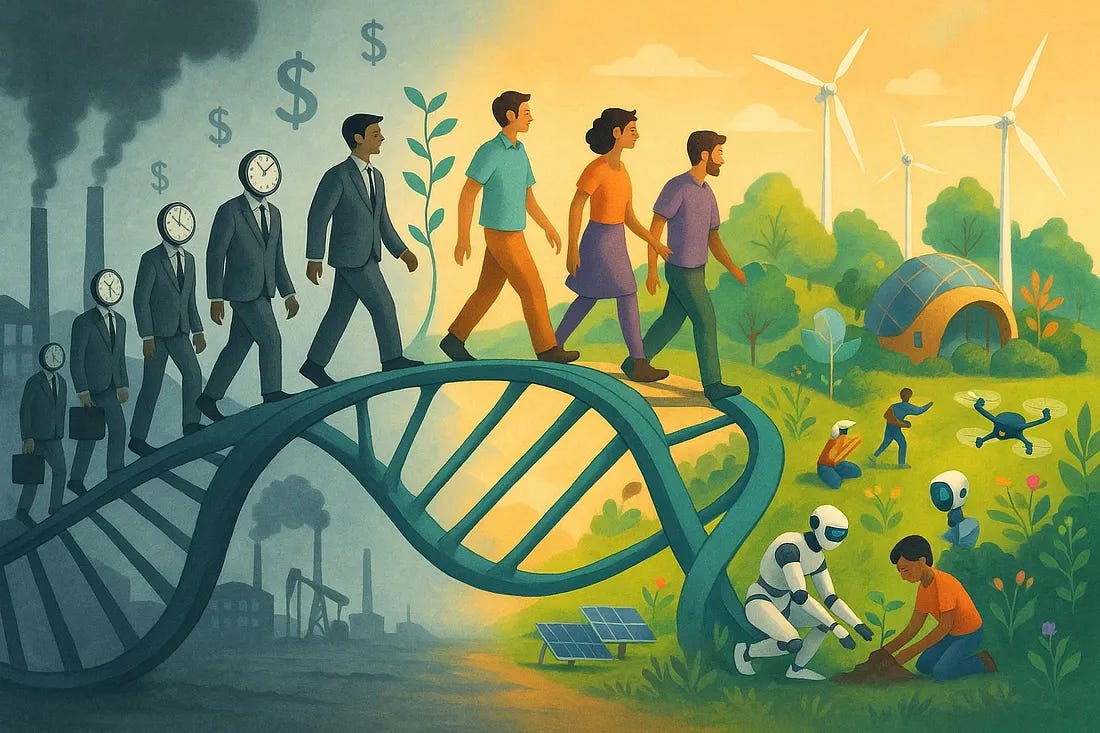
Universal Basic Income — everyone receives a living wage no exceptions. It’s necessary for the survival of the species. Here’s why.
I’ve watched countless debates about Universal Basic Income over the years. Arguments about affordability, inflation risks, and incentive structures fill economic forums and political panels. But these discussions miss the point entirely. UBI isn’t fundamentally an economic policy — it’s a consciousness revolution disguised as one.
This hit me recently at a barbecue when someone turned to me and asked, “So what do you do?” Before I could answer, I caught myself feeling a familiar discomfort. Years ago, I would have launched straight into defining my entire existence through my job title, “I’m a director of AI…” Yuck. Now I find different ways to respond. Why did we ever start doing that? When meeting someone new, that question emerges as the default — not “what do you value?” or “what are you passionate about?” We’ve stitched our identities so tightly to our employment that many can barely distinguish themselves from their labour.
This mental framework didn’t appear by accident. It emerged from centuries of scarcity economics where human value became measured by productive output. That mindset made sense when resources were genuinely limited, when human muscle and ingenuity directly corresponded to survival. But that world is rapidly disappearing, and our consciousness lags dangerously behind.
Three critical shifts in thinking
For UBI to work, we need three fundamental shifts in consciousness:
First, we must decouple human worth from employment. This change proves the most challenging for Western societies, where productivity has mutated from means to identity. We’ve created a world where the unemployed face not just financial hardship but existential crisis. “Who am I, if not my job?” becomes an unbearable question.
This connection between work and worth doesn’t just devalue humans generally — it creates practical hierarchies based on who performs what labour. Women globally perform unpaid care work worth approximately €9.7 trillion annually — labour essential to society yet invisible in economic calculations such as GDP. Similarly, disabilities become defined primarily as limitations on employability rather than different ways of experiencing the world. These aren’t abstract concerns but concrete economic distortions that systematically undervalue certain contributions based entirely on who performs them.
Second, we must transition from scarcity thinking to abundance recognition. Consider how we’ve been taught to conserve energy and water as though they will inevitably run out. Yet technological progress transforms this assumption. As renewable energy from wind, solar, hydro, and advanced nuclear approaches zero marginal cost, we gain virtually unlimited energy. Hydro power, especially innovations in tidal and wave energy, shows particular promise — not only generating consistent power but often doubling as desalination systems when positioned offshore. So with unlimited energy comes unlimited clean water through desalination and atmospheric harvesting.
This near-zero energy cost transforms everything in ways most people fail to grasp. Logistics and transportation — traditionally major cost factors in global trade — become negligible when electric vehicles and automated shipping operate on virtually free power. Manufacturing can decentralize, with small-scale local production becoming economically viable rather than centralised mass production. Energy-intensive processes like aluminium smelting, vertical farming in any climate, or converting atmospheric CO2 into materials become practical anywhere. General material transformation becomes vastly cheaper — we can redirect energy to recycle complex materials or synthesize alternatives from abundant elements. The ability to harvest resources from previously uneconomical sources (like extracting minerals from seawater or low-grade ores or space) further undermines scarcity assumptions. Yet despite this cascade of abundance potential being unlocked every day now, our economic frameworks, political systems, and individual mindsets remain trapped in zero-sum thinking from an age of genuine scarcity.
Now, imagine you’re enjoying a peaceful afternoon in the park when suddenly, dark clouds gather and rain begins pouring down unexpectedly. What’s your first instinct?
If you said you’d dance in the rain or immediately run for shelter, you probably grew up in a country colonized by Europe in its past. If instead you said you’d look around to see if elderly people, children or anyone else needed help first, you likely grew up in Asia, the Middle East, or another region with stronger collectivist traditions.
This simple thought experiment reveals how deeply cultural programming shapes our instinctive responses. Neither approach is inherently wrong, but a world facing increasingly complex global challenges requires collective thinking alongside individual freedom. Countries with more collectivist orientations — like those in Scandinavia, or in Japan, and parts of East Asia — often show greater readiness to implement systems that benefit the whole, even when individual sacrifice might be required. So the third fundamental shift is that we must balance individualism with collectivism.
The cultural readiness factor
These mental shifts explain why some societies appear more receptive to UBI than others. It’s no coincidence that Scandinavian countries lead UBI experiments — their social consciousness already leans collectivist, valuing community wellbeing alongside individual achievement.
Finland’s 2017–2018 UBI experiment didn’t fail because the economics didn’t work. Researchers found recipients showed better mental wellbeing and slightly higher employment levels compared to control groups. The real challenge wasn’t affordability but compatibility with existing value systems.
Meanwhile, Japan’s growing interest in basic income stems partly from its cultural emphasis on group harmony and societal balance. Their ageing population and early adoption of automation create practical pressures, but their collectivist mindset provides fertile ground for the necessary consciousness shift.
This community-oriented mindset naturally extends beyond basic income to addressing structural imbalances. Countries with stronger communal values tend to develop comprehensive systems that recognise different needs — not from ideological positions but from practical awareness of shared wellbeing.
The evidence appears in measurable outcomes: nations that prioritise group welfare consistently show lower rates of homelessness, substance abuse, and untreated mental illness across all demographic groups. They achieve this through systems where communities recognise interdependence rather than independence as the path to broader prosperity. Put simply, societies that habitually check whether others need help during unexpected rain storms tend to build economic systems that do the same during unexpected life challenges.
By contrast, strongly individualist societies, like the USA and UK struggle conceptually with “getting something for nothing” — a framing that betrays their underlying value system where worth equals work.
The abundance mindset challenge
I grew up like most of us, taught that resources exist in limited supply. “Turn off the lights when you leave the room”, “eat all your food”, became mantras in my childhood home — not to save money but because energy and food were treated as inherently scarce.
But technological progress has begun rendering this assumption obsolete. Solar power costs have fallen by 89% since 2010. Wind power continues its steep decline in cost. Hydro power shows enormous potential to outperform other renewables in certain contexts. Nuclear fusion, once dismissed as perpetually 30 years away, now shows commercial promise within a decade. When energy approaches a near-zero cost our scarcity-based economic models no longer make sense.
The same reduced-cost, decentralised transformation appears in manufacturing (3D printing), food production (vertical farming), and knowledge work (AI systems). Each breakthrough pushes us further from scarcity toward abundance… and AI is making those breakthroughs happen weekly across every industry and endeavour.
UBI represents one mechanism for bridging this gap between outdated distribution systems and technological abundance. Implementing it successfully requires more than economic calculations — it demands a fundamental shift in how we perceive human value, resources, and our relationship to each other.
Technology acceleration makes this urgent
Automation and AI accelerate these pressures daily. Oxford researchers estimate 47% of US jobs face high automation risk within 20 years. McKinsey projects 375 million workers (14% of the global workforce) will need to switch occupational categories by 2030 due to automation. Personally I think these timelines do not take into account the accelerated rate of change itself. I calculate these changes to be about 2–3 years away.
This shift appears neither temporary nor reversible. Unlike previous technological revolutions that created as many jobs as they eliminated, AI and robotics increasingly handle both physical AND cognitive tasks. The jobs disappearing won’t be replaced one-for-one.
The economic implications seem stark. Without employment-based income distribution, the entire structure of our economy collapses. Markets require consumers with purchasing power. Production without consumption creates crisis, not prosperity.
We face a fundamental choice: restructure our economic systems to distribute resources independently of employment, or watch as the economy collapses under the weight of unprecedented abundance alongside devastating poverty.
The implementation obstacles
The greatest barriers to effective UBI implementation aren’t economic but psychological. When we attempt to overlay UBI onto existing economic orthodoxy, we encounter predictable resistance:
“People will become lazy” — reflects the belief that humans only contribute when financially coerced.
“We can’t afford it” — assumes continued scarcity despite technological abundance.
“It’s not fair to those who work” — presupposes employment as the only valid contribution to society.
These objections do not stem from economic reality but from worldviews as outdated as colonialism itself. The evidence contradicts them directly. Well-designed studies like Stockton, California’s Universal Basic Income experiment found recipients secured full-time work at twice the rate of non-recipients — directly disproving the laziness hypothesis. Affordability calculations based on current taxation ignore the massive productivity increases that automation delivers. And the “fairness” argument collapses when we recognize the arbitrary and often exploitative nature of what our economy currently values as “work.”
Yet policy discussions remain trapped in these obsolete frameworks, attempting to solve 21st century challenges with 19th century economic assumptions. In the near future we can pay people not to go to work — where they do jobs they dislike; instead pass production to AI and the humans that really want to be there. This will save companies and governments billions.
The evidence supporting UBI’s effectiveness appears strongest precisely where current systems fail most dramatically. Finland’s experiment showed particularly significant benefits for families with children, immigrants, and those with lower incomes. Namibia’s pilot program demonstrated notable improvements in women’s financial independence and community-wide health outcomes. These results don’t stem from ideological positions but from addressing practical economic distortions that current systems perpetuate despite their measurable costs to overall prosperity.

The capitalist paradox
Those with concentrated wealth and power will never voluntarily surrender their position — or so conventional wisdom suggests. This analysis misses the fundamental contradiction now emerging within capitalism itself. The same forces that have allowed unprecedented wealth concentration are rapidly eroding capitalism’s foundation.
Consider what happens as the wealthiest players increasingly replace human workers with AI and robotics. Every automated warehouse, every algorithmic manager, every robot-staffed factory accelerates two simultaneous trends: more wealth funneling to the top and fewer consumers with disposable income below. This creates a mathematically inevitable breaking point — what use is owning the means of production when nobody can afford what you produce?
The brutal truth confronting the capitalist elite isn’t whether they’ll “allow” UBI, but whether they’ll recognize their own self-interest in implementing it before collapse forces their hand. Without consumers, capitalism dies. Without a middle class, markets disintegrate. Without distributed purchasing power, the entire premise of mass production becomes obsolete.
We’re witnessing the early symptoms already. The hollowing middle class. The rise of subscription models replacing ownership. The increasing dependence on debt to maintain consumption. The desperate attempts to financialise everything from housing to education. These aren’t sustainable strategies — they’re last-gasp efforts to maintain a fundamentally broken system.
Meanwhile, the technological forces driving automation simultaneously enable radical decentralisation. Small communities gain capacity to become self-sufficient through distributed energy, local manufacturing, and resource reclamation. Information and capability — once carefully controlled — now spread despite desperate attempts to maintain proprietary advantage. The 3D printer, the small-scale energy system, the open-source AI — these tools don’t just change how things are made, they undermine centralised control itself.
The wealthy face an uncomfortable reality: the technologies securing current dominance carry the seeds of its destruction. Their choice increasingly narrows to two paths: implement mechanisms like UBI that maintain some version of market capitalism while redistributing purchasing power, or watch their empires of production become monuments with no purpose in a world where no one can buy what they create.
This isn’t idealism or wishful thinking. It’s cold economic calculus. Maintaining concentrated power means nothing if that power governs empty markets. The capitalist who automates all labour while opposing redistribution resembles nothing so much as a dragon atop a useless pile of gold in an abandoned kingdom.
So yes, resistance from power centers exists and will continue. But it operates against mathematical inevitability. The choice facing the powerful isn’t whether to maintain the status quo — that option disappears with each automated job and each advancement in decentralized production. Their actual choice is whether to adapt to new economic realities or cling to a sinking ship of outdated economic assumptions.
For the wealth class, UBI represents a last chance to salvage elements of market capitalism in an age where technology increasingly renders its fundamental premises obsolete. Those who oppose it on principle may soon discover they’ve chosen ideology over survival.
This mathematical inevitability reveals itself most starkly in communities already pushed to economic margins. The hollowing middle class affects everyone, but hits with particular force in communities where discriminatory lending practices, employment barriers and historical wealth extraction have left fewer resources to weather transition. The economic data shows undeniable patterns: identical skills command different wages, identical loan applications receive different rates, and identical economic contributions receive different valuations based entirely on who performs them. These aren’t ideological grievances but, once again, measurable market distortions that any functional economic system must address.
For the wealth class, UBI represents a last chance to salvage elements of market capitalism in an age where technology increasingly renders its fundamental premises obsolete. Those who oppose it on principle may soon discover they’ve chosen ideology over survival.
Starting with ourselves
Change begins with concrete actions we can take, not abstract philosophising. We might consider several practical approaches:
First, we can audit our language. Phrases like “earning a living” literally tie existence to economic output. “Job creators” frames employers as saviours rather than participants in a mutual exchange. “Benefit scrounger” demonises welfare’s economic support, while “tax relief” for the wealthy frames their contribution as a burden rather than a responsibility. These words function as propaganda embedded in our daily speech.
Second, we might expand our metrics of human value. Decades ago, I began asking people different questions when we met. Rather than “what do you do?”, I found myself more curious about what sparks their passion, what they value, or what they’ve learnt lately. The conversations that followed often revealed far more about the person than their job title ever could.
Third, we can explore our reactions to policy proposals like UBI. When we feel immediate resistance, perhaps we might question its source. Does our resistance stem from genuine rational analysis, or from programmed defence of a system that has conditioned our thinking from birth?
Fourth, we might examine our relationship with work itself. How would we spend our time if survival didn’t depend on employment? This question often reveals how deeply current economic frameworks have constrained our imagination of what life could become.
This is not some touchy-feely, liberal, woke, hippie movement (or whatever perceived pejorative one wants to use). This reimagination of how we value ourselves as humans ties directly to our survival as a species. Our continued existence has been almost completely assured for the last 30,000 years, but it is no longer. We now have the ability to wipe ourselves from the planet, leaving behind nothing more than a few structures that will disappear in a couple thousand years.
The hardest part? Recognising that many beliefs we hold as “common sense” or “human nature” merely represent operating instructions for a historically specific economic system — capitalism — that has existed for barely 250 years. This realisation often causes discomfort, especially for those whose identity and status depend on maintaining this system. But survival requires facing reality, regardless of discomfort.
The path forward
For UBI advocates and policymakers, the implication seems clear: economic arguments alone will never suffice. The conversation must address these deeper mental frameworks and cultural attitudes alongside policy design.
Countries further along the collectivist spectrum have natural advantages in this transition. Their social frameworks already value community wellbeing alongside individual achievement, making the mental leap less drastic.
But individualist societies can evolve too — particularly if they recognize individualism itself evolved as an adaptation to particular economic conditions that technology increasingly renders obsolete.
The coming decades will test our adaptive capacity as a species. Can our consciousness evolve as rapidly as our technology? Can we reimagine value, work, and resources before crisis forces our hand?
I believe we can, but only if we recognize that UBI represents not just a new way of distributing money, but a new way of understanding what it means to be human in an age of technological abundance.
UBI creates a foundation — a universal floor below which no one falls — but we should acknowledge it as a starting point rather than a complete solution. Some practical challenges require complementary approaches. People with disabilities often face additional costs that standard UBI wouldn’t fully address. Communities with historical disadvantages might need targeted infrastructure investment alongside individual income support. These needs recognise that different circumstances sometimes require different supports to achieve meaningful equity — with or without UBI. Economic data consistently shows that societies addressing these varied needs see better outcomes across all measurements of wellbeing, from health to education to innovation.
This doesn’t mean every concern about implementation deserves dismissal. Valid questions about inflation, transition mechanisms, how we pay for it and incentive structures require thoughtful answers — which exist and will form the subject of future writing. But these technical challenges pale compared to the consciousness shift required.
The question isn’t whether we can afford Universal Basic Income. The question is whether we can afford to remain trapped in outdated ways of thinking while technology transforms the material conditions of our existence.
The economic policy we call UBI is merely the how. The consciousness revolution it represents is the why — and ultimately, the greater challenge.
This has been written as a collaboration between chatGPT, Claude, Perplexity, and a neurodivergent human with input from economists, AI engineers, and a fashion stylist (because, why not?) cauri is writing his next book, futureproofing society: the case for universal basic income in the age of AI, all about how to make this transition practical.
I relate to so much of what you are saying here. That what is demanded is a cultural shift. Trying to address the problem using the mechanics of the existing faulty operating system just perpetuates the glitches. I see this as being fundamentally about our confusion of the tool (our economic paradigm and its structures) with the reality that the tool was created to facilitate (the production of food, shelter, education, care, etc,etc) The "tool" has in many places come to determine what we do or don't do - rather than whether it is actually practically possible. The "wall of financial feasibility" is the mechanism by which this error protects itself. This wall isn't a physical limit of our resources; it is the point where the created structure of money is allowed to override the physical reality of our production capacity. The wall isn't made of bricks; it's made of ink. It is a logic error masquerading as a practical constraint. As Keynes once said: "anything we can do, we can afford". You may be interested in my website - unemploymentisgood.com