

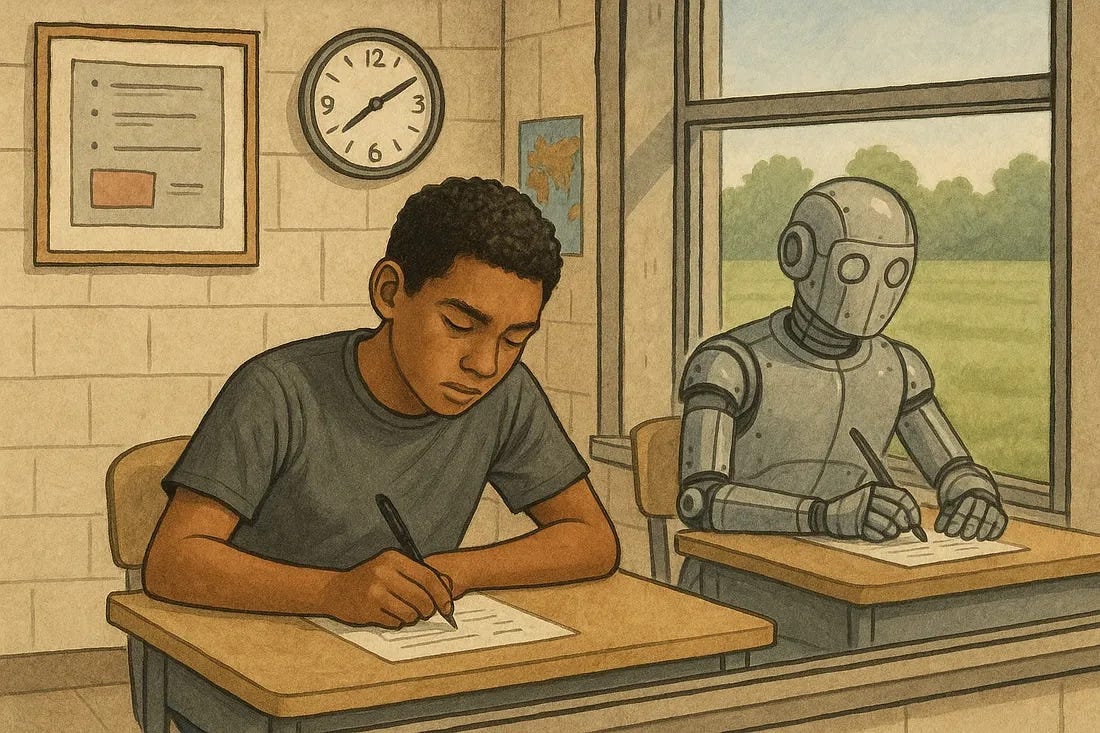
Recently, three different people asked me the same question in three different settings. At an AI conference, during a political leadership workshop for women, and over lunch with a podcaster friend — they all wanted to know: “Does AI destroy students’ ability to think critically?”
The lawyer preparing to enter politics looked particularly concerned. She worried that students using AI to write papers would never develop critical thinking skills.
I told her about teaching my son physics.
Starting at the end
Most schools teach science like archaeology — digging through layers of ancient discoveries. First comes Aristotle’s four elements. Then we explain why Aristotle got it wrong. Later comes Newton’s laws. Then we explain what Newton missed. Layer after layer of corrections, building a scaffolding of errors that students must first learn, then unlearn.
My son and I started with Feynman and quantum mechanics. We dove straight into quantum chromodynamics, wave-particle duality, the uncertainty principle. His young brain, unencumbered by classical physics, absorbed these concepts as naturally as learning the alphabet.
From quantum gravity, we worked backwards through subatomic particles, into molecules and chemistry, then biology, geology, space, and cosmology. Always starting with what we know now, then exploring what led us there.
The results? He grasps scientific concepts that baffle adults who learned the “proper” way. Not because he possesses some special genius, but because nobody told him these ideas should seem weird.
The factory model
Why does traditional education teach backwards? The answer lies in 19th-century Prussia, where they designed schools to create factory workers and soldiers. The system prioritised memorisation, standardisation, and compliance. Learn the facts. Repeat them correctly. Don’t question the process.
This way of learning embraces the scaffolding approach where information gets pre-digested into artificial layers from ‘simple’ to ‘complex,’ removing the very difficulty that makes learning stick.
The irony being that by making everything “easier” and more “logical,” we actually make it harder for students to truly learn and remember. The brain needs that struggle, that effort of making connections.
The British Empire exported the repetition model globally. Countries from India to Mexico to Kenya replaced oral traditions and apprenticeship learning with written exams demanding regurgitated facts. Japan’s Meiji Restoration adopted Western models while keeping Confucian memorisation traditions. China’s post-1905 reforms ironically made their already memorisation-heavy system even more rigid.
We inherited an education system built for a different world — one that needed human calculators and filing cabinets, not creative thinkers and problem solvers.
The evidence surrounds us
Look at what this system produces:
LinkedIn’s 2024 Global Talent Trends report lists “critical thinking” as the #1 skill gap
MIT research shows false information spreads six times faster than truth on social media
The V-Dem Institute finds correlations between memorisation-heavy education and democratic backsliding — look at Turkey, Hungary, the Philippines, and increasingly the USA, where standardised testing culture coincides with declining democratic norms
Studies in Nature Human Behaviour show people increasingly rely on social proof over logical evaluation
When hiring managers can’t find people who can solve problems, when false information spreads unchecked, when citizens stop questioning authority — these symptoms point to something deeper than technology.
Garbage in, garbage out (still true)
“But AI writes sophisticated essays!” people protest.
Yes, and those essays all look the same. Ask ChatGPT to “write a paper about The Great Gatsby” and you’ll get eloquent mediocrity. Superlatives everywhere. Em-dashes galore. Phrases like “not only… but also” repeated ad nauseam. Any experienced educator spots these papers immediately.
But watch what happens with a different prompt: “I think The Great Gatsby works as a metaphor for climate change, and I believe Gatsby himself needed therapy more than Daisy. Help me develop this argument. Here’s a sample of my writing style, make it sound like me.”
Now you get something worth reading. The difference? The student brought original thought to the conversation. The old computing phrase “garbage in, garbage out” still applies — generic questions produce generic answers, no matter how eloquently phrased by an AI.
What learning actually requires
Decades of neuroscience research reveal something delicious: our brains hate easy. They crave the struggle.
Take interleaving — the practice of mixing different types of problems together like a DJ mixing tracks. Your brain does not want to practice one type of math problem fifty times in a row. Mix algebra with geometry with calculus. Cross-referencing forces deeper learning. Musicians know this instinctively — they don’t practice scales for hours, then arpeggios for hours. They weave them together, forcing their brains to constantly switch contexts.
Or consider retrieval practice. Re-reading your notes feels productive, like highlighting every line in a textbook (we’ve all done it). But test yourself. Wait a couple of days after learning something new and then try to remember it in as much detail as possible before looking it up again. Forcing your brain to pull information from the depths without help writes the memory in permanent ink.
Generation works the same way. When you create your own examples instead of memorising someone else’s, your brain must build new neural pathways. It can’t cruise down the highway someone else paved. A student who invents their own physics problems understands physics. One who memorises textbook problems understands… textbooks.
And learning by doing? Watch a YouTube video on riding a bike. Read a manual. Study the physics of balance and momentum. Then try to ride. You’ll hit the pavement because knowledge lives in the mental spaces between our experiences.
A science teacher who talks about chemistry reaches a few students. The teacher who sets off a controlled explosion in class? They create scientists.
Back to AI
AI is not the problem. Where we need to focus sits somewhere else entirely. Education needs to teach people to be curious. To use their brains, to learn how to learn, to examine and break down ideas. These skills matter because what makes the difference is you.
When you talk with an AI, you are the element of difference — your original thought, your ability to question something that hasn’t been questioned in that way before. Your ability to make a connection between things that nobody’s ever connected. That comes from the human mind, and that’s how we benefit from collaboration.
Oh, and honesty. If we taught intellectual honesty, students would understand that using AI to replace their thinking cheats themselves more than anyone else.
Augmented, not artificial
My title is Director of AI in Artium; it actually stands for Director of Augmented Intelligence. We chose that title deliberately — even though (or perhaps “because”) I build AI platforms every day, I believe AI and humans together create something better than either one alone.
A calculator didn’t destroy our ability to understand math — it freed us from computational drudgery to explore mathematical concepts. Similarly, AI can free us from the mechanical aspects of writing and research to focus on thinking, connecting, and creating.
But only if we have thoughts worth augmenting. Only if we bring curiosity to the conversation. Only if we’ve learned to think in the first place.
The mirror, not the cause
That lawyer worried about AI destroying critical thinking? Here’s what I finally told her:
AI didn’t create the critical thinking crisis. It merely exposed it.
When students can’t defend the arguments in “their” essays, when they can’t expand on the ideas, when they accept AI’s first answer without question — AI isn’t the problem. It’s holding up a mirror to an education system that stopped teaching people to think long ago.
We stand at a crossroads. We can panic about AI and create more rules, more regulation, more ways to catch “cheating.” Or we can recognise that AI has given us a gift: undeniable evidence that our education system needs fundamental reform. Curiosity. Critical thought. Empathy. Honesty.
The choice seems obvious to me. But then again, I taught my child backwards.
Can you see things differently?
—
I wrote this article in collaboration with Claude who immediately argued that ‘“garbage in, garbage out” reference needs updating. Modern LLMs don’t quite work that way anymore, do they? They can generate sophisticated content from simple prompts. Might need a different analogy.’ We debated until it agreed: ‘The sophistication of the LLM’s language output masks the fundamental truth: generic questions produce generic (if eloquent) answers that any experienced educator can spot from across the room.’ Collaboration.